

Struggling to lose weight despite following healthy guidelines can feel frustrating and isolating. Many American adults face invisible metabolic barriers blocking progress, and simple measures like weight alone rarely tell the whole story. By focusing on a comprehensive assessment of metabolic health status, personalized nutrition foundations, and targeted hormonal and gut strategies, you gain clear direction for lasting transformation guided by science and medical expertise.
Table of Contents
- Step 1: Assess Metabolic Health Status And Identify Roadblocks
- Step 2: Establish Personalized Nutrition And Lifestyle Foundations
- Step 3: Optimize Hormonal And Gut Health Through Targeted Strategies
- Step 4: Monitor Progress And Adjust The Metabolic Health Workflow
Quick Summary
| Key Point | Explanation |
|---|---|
| 1. Assess metabolic health with professionals | Collaborate with healthcare experts for comprehensive metabolic evaluations, utilizing advanced diagnostic tools tailored to your unique needs. |
| 2. Create a personalized nutrition strategy | Develop a nutrition plan based on genetic testing and metabolic profiling for optimal health and weight loss. |
| 3. Optimize gut health and hormones | Implement targeted strategies like probiotics and stress management to enhance hormonal balance and gut microbiome health. |
| 4. Monitor progress regularly | Establish a routine for tracking key biomarkers and metrics, allowing for informed adjustments to your metabolic health strategy. |
| 5. Adapt based on individual responses | Utilize data to make personalized changes to your diet and lifestyle, ensuring your approach evolves with your body’s needs. |
Step 1: Assess metabolic health status and identify roadblocks
Understanding your metabolic health requires a strategic, data-driven approach that goes beyond simple weight measurements. Your goal in this step is to conduct a comprehensive evaluation of your body’s metabolic functions, uncovering potential barriers preventing effective weight loss.
To effectively assess your metabolic health, you’ll want to focus on several key diagnostic markers that provide insights into your body’s current metabolic state. These include:
- Blood glucose levels during fasting and postprandial periods
- Insulin sensitivity indicators
- Lipid profile measurements
- Hormonal balance assessments
- Body composition metrics
Researchers have developed advanced methods for metabolic health assessment that go beyond traditional static measurements. These approaches evaluate both your current metabolic state and your body’s homeostatic resilience – essentially mapping out how effectively your metabolism responds and adapts to different physiological conditions.
The most effective assessment involves working with healthcare professionals who can conduct comprehensive testing. This typically includes advanced blood panels, body composition analysis, and potentially continuous glucose monitoring to understand how your metabolism functions in real-world conditions. By tracking metabolic health transitions, you can identify specific roadblocks preventing weight loss and develop targeted intervention strategies.
Here is a comparison of traditional versus advanced metabolic health assessments:
| Assessment Approach | What It Measures | Depth of Insights |
|---|---|---|
| Traditional methods | Weight, basic labs | General health trends |
| Advanced methods | Dynamic biomarkers, resilience | Adaptive metabolism analysis |
| Professional assessment | Comprehensive panels, real-world data | Personalized roadblock detection |
Pro tip: Schedule a comprehensive metabolic health screening with an endocrinologist or functional medicine practitioner who specializes in metabolism, ensuring you get the most detailed and personalized assessment possible.
Step 2: Establish personalized nutrition and lifestyle foundations
Building a successful metabolic health strategy requires creating nutrition and lifestyle foundations uniquely tailored to your individual biological blueprint. Your goal is to develop a personalized approach that aligns with your specific genetic, metabolic, and physiological characteristics.
To establish these foundations, you’ll need to integrate multiple layers of personalized insights. Modern scientific approaches to personalized nutrition frameworks now leverage advanced technologies to craft precise dietary and lifestyle recommendations. Key elements of this process include:
- Genetic testing to understand inherited metabolic tendencies
- Microbiome analysis to evaluate gut health and nutrient absorption
- Metabolic profiling to assess current physiological functioning
- Hormonal assessment to identify potential metabolic disruptions
- Lifestyle factor evaluation including stress, sleep, and activity levels
By incorporating genetic nutritional insights, you can develop a nutrition strategy that goes beyond generic recommendations. This approach recognizes that your body’s response to foods, exercise, and environmental factors is uniquely yours. The goal is to create a dynamic, adaptable plan that can evolve as your metabolism changes.
Personalized nutrition is not about following a one-size-fits-all diet, but about understanding your body’s unique metabolic language and responding accordingly.
Working with a functional medicine practitioner or registered dietitian specializing in metabolic health can help you navigate this complex process. They can help you interpret genetic data, conduct comprehensive metabolic assessments, and design a nutrition plan that supports your weight loss and health goals.

The table below outlines how key factors influence personalized nutrition strategies:
| Factor | Impact on Nutrition Plan | Adaptation Rationale |
|---|---|---|
| Genetic profile | Identifies inherited tendencies | Customizes macronutrient ratios |
| Microbiome health | Shapes nutrient absorption | Tailors probiotic/prebiotic intake |
| Lifestyle habits | Modifies caloric and meal timing | Accounts for stress, activity, sleep |
Pro tip: Consider maintaining a detailed food and symptom journal to track how different nutrients and lifestyle choices impact your energy, weight, and overall metabolic response.
Step 3: Optimize hormonal and gut health through targeted strategies
Optimizing your hormonal and gut health is crucial for sustainable metabolic transformation. Your goal is to create a comprehensive approach that balances your body’s complex hormonal and microbiome ecosystems to support weight loss and overall metabolic function.
Understanding the intricate connection between gut health and hormonal balance is key. Gut microbiome research reveals that your intestinal ecosystem directly influences hormone production, energy metabolism, and satiety signals. This means strategic interventions can dramatically improve your metabolic health.
Your targeted optimization strategy should include multiple complementary approaches:
- Probiotic supplementation to enhance beneficial gut bacteria
- Prebiotic fiber intake to support microbiome diversity
- Stress management techniques to regulate cortisol levels
- Hormone-balancing nutrition focusing on whole foods
- Sleep optimization to support hormonal rhythms
Researchers have demonstrated that probiotic-prebiotic strategies can effectively modulate endocrine function and metabolic regulation. By carefully selecting interventions that support both gut and hormonal health, you can create a powerful foundation for sustainable weight loss.
Your gut is not just a digestive system – it’s a complex communication network that plays a critical role in your metabolic health.
Working with functional medicine practitioners can help you develop a personalized approach that addresses your unique hormonal and microbiome profile. Advanced testing can provide insights into potential imbalances and guide targeted interventions.
Pro tip: Introduce probiotic and prebiotic foods gradually, monitoring your body’s response and adjusting your strategy based on how you feel.
Step 4: Monitor progress and adjust the metabolic health workflow
Successful metabolic transformation requires consistent monitoring and intelligent adaptation of your health strategy. Your goal is to develop a dynamic tracking system that provides real-time insights into your body’s metabolic responses and enables precise, personalized adjustments.
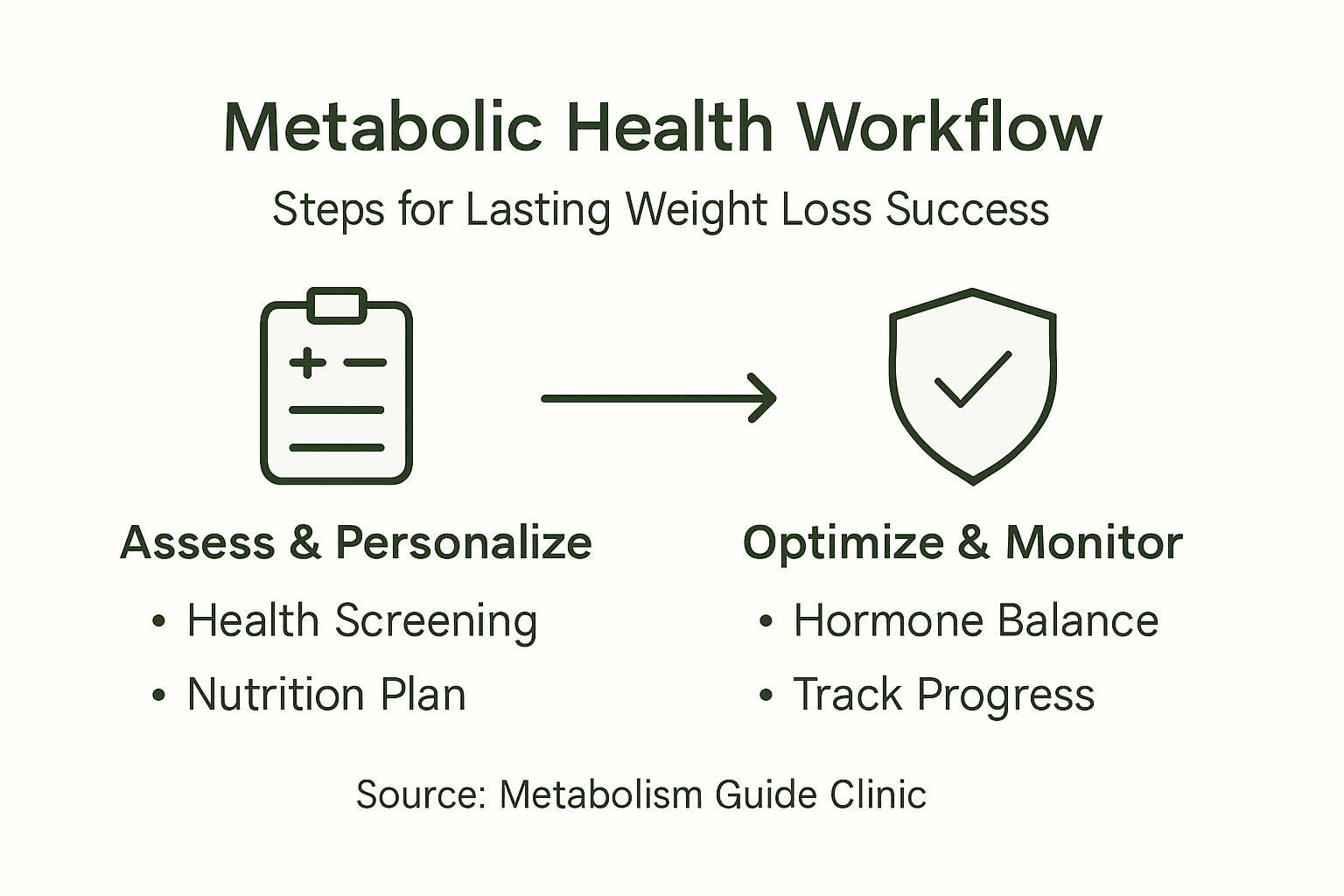
Longitudinal digital monitoring offers unprecedented opportunities to track your metabolic health with unprecedented precision. By systematically measuring key biomarkers like blood glucose, ketones, and metabolic indicators, you can create a comprehensive view of your body’s changing physiological landscape.
Your monitoring strategy should include multiple comprehensive tracking methods:
- Quantitative biomarker tracking including blood tests and metabolic panels
- Body composition analysis measuring fat percentage and muscle mass
- Continuous glucose monitoring to understand metabolic responses
- Fitness performance metrics tracking strength and endurance
- Symptom and energy level journaling for holistic assessment
Researchers emphasize that systematic metabolic monitoring reveals critical insights about individual metabolic health trajectories. By establishing a consistent evaluation framework, you can identify patterns, detect potential roadblocks, and make informed adjustments to your metabolic health workflow.
Effective metabolic monitoring is not about perfection, but about understanding your body’s unique response patterns and adapting intelligently.
Consider working with healthcare professionals who can help you interpret complex data and provide nuanced guidance. Advanced tracking technologies and professional insights can transform your approach from generic to genuinely personalized.
Pro tip: Create a monthly review ritual where you systematically analyze your tracking data, celebrating progress and strategically adjusting your approach based on objective insights.
Take Control of Your Metabolic Health Journey Today
If you have struggled with persistent weight loss roadblocks like hormonal imbalances, gut health issues, or ineffective dieting strategies, you are not alone. This article highlights the importance of a personalized metabolic health workflow that goes beyond calorie counting to assess your unique biology, optimize nutrition, and monitor progress dynamically. Key challenges such as identifying metabolic disruptions and tailoring lifestyle changes require expert guidance and structured education.
Unlock lasting weight loss success on your own terms with the doctor-led, science-driven programs at Metabolism Guide. Our easy-to-follow educational modules and virtual community support empower you to understand how hormones, metabolism, and gut health influence your weight. Stop wasting time on fad diets and start leveraging clear, evidence-based strategies designed specifically for your body’s needs. Take the next step to transform your health with personalized insights and sustainable lifestyle foundations at Metabolism Guide. Visit us now and build the metabolic health workflow that finally works for you.
Frequently Asked Questions
What is the first step in the Metabolic Health Workflow for Lasting Weight Loss Success?
Understanding your metabolic health starts with assessing your metabolic health status and identifying any roadblocks. Focus on key diagnostic markers such as blood glucose levels and body composition metrics to gain insights into your current metabolic state.
How can I establish personalized nutrition and lifestyle foundations?
To create personalized nutrition and lifestyle foundations, integrate elements like genetic testing and microbiome analysis to align your diet with your unique metabolic profile. Work with a healthcare professional to develop a tailored plan based on your individual characteristics.
What strategies can I use to optimize hormonal and gut health?
To optimize hormonal and gut health, consider implementing probiotic supplementation and increasing prebiotic fiber intake while focusing on stress management and quality sleep. Start by introducing these changes gradually, monitoring your body’s response over the next few weeks.
How do I effectively monitor my progress in the metabolic health workflow?
Establish a monitoring system that includes tracking quantitative biomarkers, body composition, and fitness performance metrics. Create a monthly review routine to analyze your data, identify patterns, and adjust your approach based on the insights you gather.
Why is assessing metabolic health important for weight loss?
Assessing your metabolic health is crucial for uncovering specific roadblocks that may hinder weight loss. A comprehensive evaluation can guide you in developing targeted intervention strategies that are personalized to your body’s needs.
What are the benefits of working with healthcare professionals in this workflow?
Working with healthcare professionals can provide you with personalized insights, help you interpret testing data, and guide you through the complexities of the metabolic health workflow. This collaboration can lead to more effective and sustainable weight loss strategies tailored to your unique situation.
