

Many Americans try countless popular diets, shed weight fast, and then watch the pounds return even quicker. Facing repeated disappointment is discouraging, especially when lasting change seems impossible. Understanding the science behind hormones, gut health, and metabolism holds the key to sustainable weight loss that fits real life and works long-term. This guide breaks down common myths and explains how to support your body with strategies grounded in biological research, not passing trends.
Table of Contents
- Defining Sustainable Weight Loss And Myths
- Types Of Weight Loss Approaches Compared
- Hormones, Gut Health, And Metabolism
- Behavioral Strategies For Lasting Change
- Risks Of Quick Fixes And Common Pitfalls
- Science-Driven Solutions For Real Results
Key Takeaways
| Point | Details |
|---|---|
| Sustainable Weight Loss | Achieve weight loss by making consistent lifestyle changes rather than through restrictive diets, aiming for 1 to 2 pounds per week. |
| Hormonal Balance | Focus on gut health and hormonal regulation to manage appetite and weight effectively, rather than solely counting calories. |
| Behavioral Strategies | Implement self-monitoring and accountability partnerships to foster lasting change in eating habits. |
| Personalization of Approaches | Tailor weight loss strategies to individual metabolic responses and preferences for optimal results. |
Defining Sustainable Weight Loss and Myths
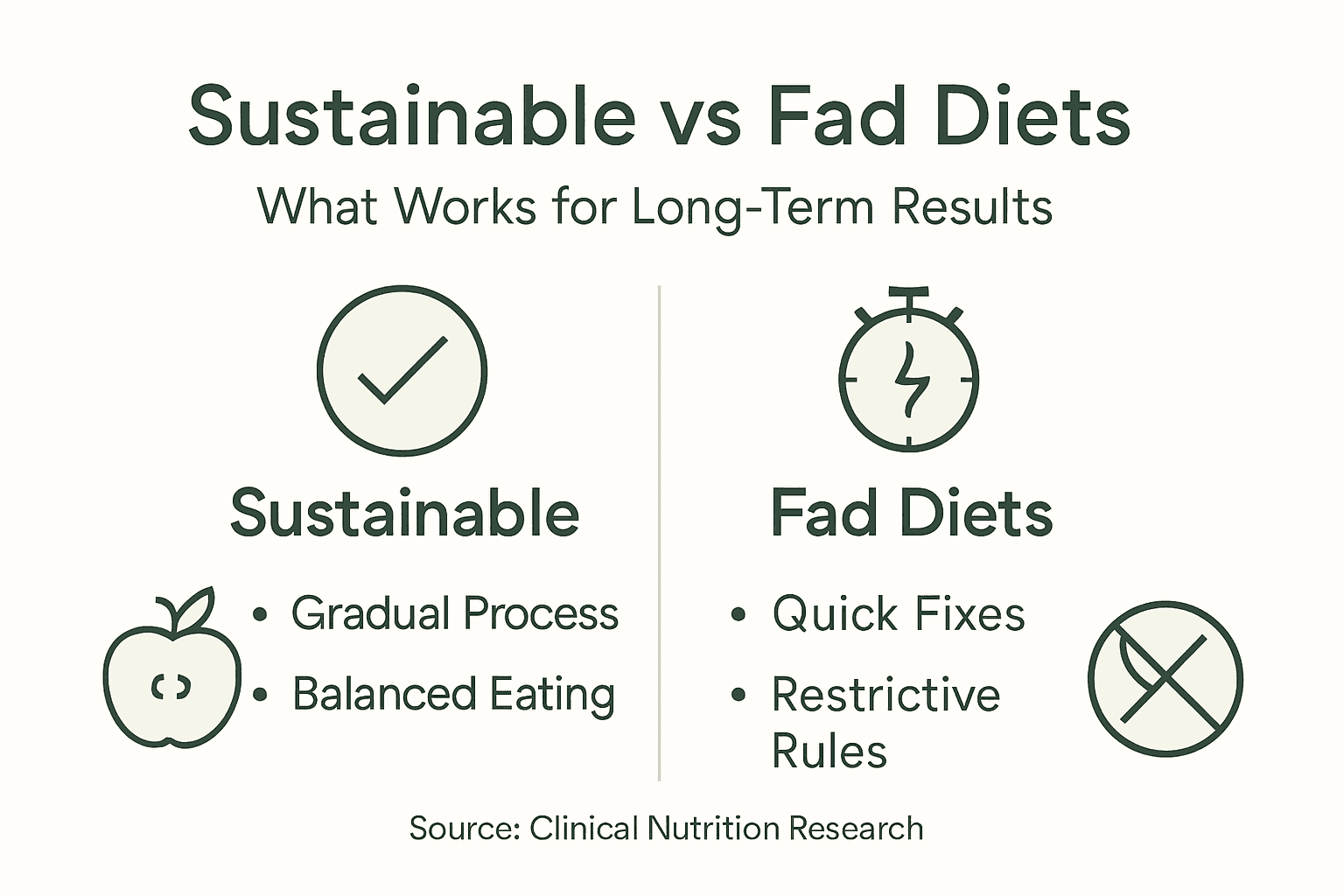
Sustainable weight loss means losing weight at a pace your body can actually maintain long-term while preserving muscle, energy, and overall health. Most experts agree this means 1 to 2 pounds per week through a combination of balanced nutrition and lifestyle changes. This isn’t about perfection or restriction. It’s about building habits that fit your real life.
Fad diets promise rapid results by cutting entire food groups, drastically slashing calories, or following rigid rules that nobody can sustain. The problem? They work temporarily. Your body drops water weight and muscle quickly, creating that thrilling scale victory everyone chases. Then you stop the diet because, realistically, who can eat nothing but grapefruit or skip all carbohydrates forever? The weight comes back, often with extra pounds attached. This cycle of rapid weight loss and regain is called yo-yo dieting, and research shows fad diets lead to weight cycling that can harm your metabolism over time.
The real myth? That sustainable weight loss requires deprivation. It doesn’t. Your body is designed to regulate hunger, fullness, and energy balance when you work with your hormones instead of against them. Sustainable approaches focus on consistency over perfection, balanced nutrition that includes foods you actually enjoy, and gradual shifts in how you move and rest. This is why understanding your unique metabolic responses matters more than following someone else’s rigid meal plan.
One dangerous misconception is that weight loss speed equals success. Faster isn’t better. When you lose weight too quickly, your body fights back through increased hunger hormones and decreased metabolic rate. You’re left hungrier and more fatigued. Sustainable weight loss works differently. You’re changing your relationship with food, movement, and stress in ways that feel manageable now and forever.
Another common myth is that calories are all that matter. The truth is more complex. Your hormones, gut health, sleep quality, and stress levels influence whether calories are stored as fat or used for energy. Two people eating 2000 calories can have completely different weight outcomes based on their insulin sensitivity, cortisol levels, and digestive health.
Pro tip: Start by tracking not just what you eat, but when you feel most hungry, energized, or crave specific foods. These patterns reveal your body’s unique signals, helping you build a sustainable approach tailored to your physiology rather than chasing someone else’s diet.
Types of Weight Loss Approaches Compared
When it comes to losing weight, you have several distinct approaches to choose from. Each has different mechanics, timelines, and real-world sustainability. Understanding how they actually work helps you pick something that aligns with your life and your body’s needs.
Lifestyle modifications through diet and physical activity represent the first category. This approach focuses on changing what and how much you eat, plus adding movement to your day. The advantage? It’s free, builds lasting habits, and improves health markers beyond just the scale. Strength training preserves muscle while calories drop. Better sleep and stress management improve hunger hormones. These changes work together. The drawback is patience. Lifestyle changes typically deliver slower initial results, which frustrates people expecting quick transformations.

Caloric restriction regimens come in several flavors. Alternate day fasting, time-restricted eating, and continuous energy restriction are all different ways to reduce overall calorie intake. Research comparing these fasting regimens shows they produce weight loss, but their effectiveness varies based on individual adherence. Some people thrive with time-restricted eating, eating only during an 8-hour window. Others find alternate day fasting unsustainable because the hunger becomes unbearable. The critical insight is that the best calorie restriction approach is the one you can actually stick with.
Pharmacotherapy involves medical treatments like prescription medications or injectable medications designed to reduce appetite or alter metabolism. These work faster than lifestyle changes alone and can help people break through plateaus. However, they come with potential side effects, require medical supervision, and often cost significantly. Comparing lifestyle modifications against pharmacotherapy reveals that combined approaches work better than either alone. Weight loss medications work best when paired with dietary changes and exercise.
The hybrid approach combines multiple strategies. You might use time-restricted eating with strength training, or add a medication while improving your sleep and stress management. This is why understanding your hormones, gut health, and unique metabolic responses matters so much. Your body doesn’t follow a generic playbook.
Here’s a comparison of popular weight loss approaches and their most notable strengths and limitations:
| Approach | Typical Timeline | Key Strength | Primary Limitation |
|---|---|---|---|
| Lifestyle Modification | Slow, 12+ weeks | Builds lasting habits | Requires patience |
| Caloric Restriction | Fast to moderate | Simple to implement | Hard to sustain long-term |
| Pharmacotherapy | Rapid results | Breaks plateaus quickly | Possible side effects, cost |
| Hybrid Strategy | Moderate to long | Addresses multiple factors | Needs careful personalization |
Pro tip: Start with lifestyle modifications for at least 12 weeks before considering medications. This gives your body time to adapt, reveals which habits actually work for you, and establishes baseline metabolic health that medications can then enhance.
Hormones, Gut Health, and Metabolism
Your body is not a simple calculator where calories in minus calories out equals weight loss. It’s a complex biological system where hormones orchestrate nearly everything. When these hormones work against you, losing weight becomes nearly impossible no matter how hard you try. When they work with you, weight loss happens almost naturally.
Insulin is perhaps the most critical hormone for weight management. This hormone controls whether the calories you eat get stored as fat or used for energy. When your insulin sensitivity drops, your body stores more calories as fat and burns less. High stress, poor sleep, and excessive refined carbohydrates all spike insulin and reduce sensitivity over time. Your pancreas works harder and harder, eventually leading to resistance. This is why two people eating the same calories can have completely different outcomes.
Leptin and ghrelin are your appetite regulators. Leptin signals fullness. Ghrelin signals hunger. When your gut health suffers, these hormones get disrupted. Altered gut microbes increase appetite hormones and insulin secretion, creating a biological drive to eat more. Your willpower can’t override a hormonal imbalance. This is why “just eat less” fails for so many people.
Your gut microbiome influences far more than digestion. Trillions of bacteria in your intestines produce neurotransmitters, regulate inflammation, and control hormone production. A healthy microbiome includes diverse bacteria that produce short-chain fatty acids, which improve insulin sensitivity and reduce inflammation. Poor diet, stress, and antibiotics destroy this diversity. An unhealthy microbiome drives cravings, increases inflammation, and makes weight loss metabolically harder.
Cortisol, your stress hormone, directly impacts fat storage. Chronic stress keeps cortisol elevated, which signals your body to store fat, especially around the midsection. Elevated cortisol also increases appetite and disrupts sleep quality, creating a vicious cycle. Understanding how hormones regulate metabolism reveals that sleep deprivation alone can reduce insulin sensitivity by 25 percent in just one week.
The breakthrough understanding is this: sustainable weight loss requires working with your hormonal system, not against it. Your metabolism adapts based on sleep, stress, movement, and what you eat. Addressing gut health, stabilizing blood sugar, and improving sleep aren’t optional extras. They’re foundational.
To clarify the influence of hormones and gut health on weight management, consider this breakdown:
| Biological Factor | Main Role | Impact on Weight Loss |
|---|---|---|
| Insulin Sensitivity | Controls fat storage | Low sensitivity hinders fat burning |
| Gut Microbiome Diversity | Regulates appetite signals | Poor diversity increases cravings |
| Cortisol Levels | Triggers fat storage | Chronic stress slows progress |
| Appetite Hormones | Manage hunger/fullness | Imbalance leads to overeating |
Pro tip: Focus on adding foods that support gut health (fermented foods, fiber-rich vegetables, omega-3s) rather than purely restricting calories, since a healthy microbiome directly improves your hunger hormones and metabolic rate.
Behavioral Strategies for Lasting Change
Willpower alone won’t sustain weight loss. Your brain needs structure, feedback, and support to rewire decades of eating habits. The good news? Behavioral strategies backed by science work remarkably well when you implement them correctly.
Self-monitoring is your foundation. Tracking what you eat, how you feel, and your energy levels creates awareness that naturally shifts behavior. But here’s the catch: tracking alone without feedback often fails. Behavioral interventions combining self-monitoring with coaching significantly improve weight loss compared to going it alone. This is why journaling works better than just thinking about your habits.
Externally imposed structure matters more than internal motivation. Your brain is wired to conserve energy and avoid discomfort. When you rely purely on willpower, you’ll eventually lose the battle. Instead, build systems that make the healthy choice automatic. Plan meals in advance. Prep vegetables on Sunday. Keep tempting foods out of your house. Remove friction from good choices and add friction to bad ones.
Accountability partnerships reshape your behavior more powerfully than most people realize. When someone else knows your goals, you’re far more likely to follow through. This is why group weight loss programs work better than solo attempts. Even virtual coaching provides enough external pressure to keep you consistent when motivation dips.
Addressing both dietary and psychological components matters for lasting success. Structured behavioral programs addressing food choices and emotional eating produce clinically meaningful weight loss and better long-term retention. Many people eat when stressed, bored, or anxious rather than physically hungry. Identifying your emotional triggers and developing alternative responses is just as important as knowing macronutrient ratios. Learning to sit with discomfort instead of reaching for food fundamentally changes your relationship with eating.
Small, consistent actions compound. Losing 50 pounds through radical restriction and willpower typically leads to regain. Losing 50 pounds through tiny habit changes over 18 months sticks because it becomes your normal. The key is progress, not perfection. One better decision today, one tomorrow, one next week.
Pro tip: Pair your weight loss goals with someone else’s goal, even if it’s not weight-related, and check in weekly. External accountability is one of the strongest predictors of sustained behavior change.
Risks of Quick Fixes and Common Pitfalls
Quick-fix weight loss approaches feel amazing at first. The scale drops rapidly. Your clothes fit better. Friends notice the change. Then reality sets in. Your body fights back with increased hunger, fatigue, and cravings. Within months, the weight returns. This cycle damages not just your confidence but also your metabolism.
Rapid weight loss techniques create serious physiological problems. Common risks of rapid weight loss include dehydration and nutrient deficiencies, which weaken your immune system, damage your heart, and disrupt your hormones. When you lose more than 2 to 3 pounds per week, you’re losing significant muscle tissue along with fat. This metabolic damage lingers long after you stop dieting.
Your body has powerful metabolic defenses. Lose weight too fast and your hunger hormones spike while fullness hormones plummet. Your resting metabolic rate drops, meaning you burn fewer calories at rest. This is adaptive thermogenesis, and it’s why people regain weight so easily after crash diets. Your body literally becomes more efficient at storing fat.
Psychological damage from quick-fix approaches often goes unmentioned. Restrictive diets breed obsessive thinking about food. You feel deprived. You develop an unhealthy relationship with eating where certain foods become forbidden. When you inevitably eat them, shame and guilt follow. This emotional cycle makes sustainable change harder because you’re fighting both biological hunger and psychological distress.
Why do quick-fix programs fail long-term? Quick-fix approaches fail because they address weight without addressing lifestyle and psychological factors. You lose weight temporarily but never develop the habits, knowledge, or emotional tools to keep it off. You’re not learning why you overeat. You’re not fixing your sleep or stress. You’re not healing your gut. When the diet ends, you return to your old life and your old weight follows.
The most dangerous pitfall is the false hope cycle. Each new diet promises to be different. You invest emotional energy. You sacrifice. You fail again. Each cycle erodes your belief that lasting change is possible. This learned helplessness makes future attempts harder because you expect failure.
Pro tip: If a weight loss approach requires extreme restriction, eliminates entire food groups, or promises results faster than 1 to 2 pounds weekly, it’s almost certainly unsustainable and potentially harmful.
Science-Driven Solutions for Real Results
Science-driven weight loss looks completely different from what you see on social media. It’s not flashy. It doesn’t promise overnight transformation. But it works because it addresses root causes instead of symptoms. Real results come from understanding your unique biology and building a strategy that works with your body, not against it.
The foundation is personalization. Your metabolism, hormones, and gut health are as unique as your fingerprint. A Mediterranean diet works beautifully for some people while others thrive on a different macronutrient balance. The science recognizes this variability. Integrating nutritional strategies with medical approaches creates sustained weight loss and improved metabolic health. Your job is discovering what works for your specific body through structured experimentation and feedback.
Combining lifestyle and medication produces superior outcomes. Lifestyle modifications like improved sleep, stress management, and movement build the foundation. When appropriate, medications enhance results. Modern weight loss medications work differently than older approaches. They improve insulin sensitivity, reduce appetite hormones, and preserve muscle tissue. A holistic clinical approach integrating diet, exercise, and emerging pharmacotherapy optimizes sustainable outcomes. This combination addresses multiple biological pathways simultaneously.
Track what actually matters. Forget obsessing over daily scale fluctuations. Instead, monitor energy levels, hunger patterns, sleep quality, and how your clothes fit. These metrics reveal whether your approach is actually working at the metabolic level. The scale will follow when your biology improves.
Build progressively, not drastically. Science-driven approaches start with small changes you can sustain forever. Add a 20-minute walk three times weekly. Improve sleep by 30 minutes per night. Swap one sugary drink for water daily. These tiny shifts compound over months and years. Each small win builds confidence and proves that change is possible.
Work with professionals who understand biology. Cookie-cutter advice fails because your body isn’t cookie-cutter. A doctor or registered dietitian who understands your individual hormonal profile, metabolic rate, and psychological patterns provides guidance that actually works. They can adjust your strategy as your body adapts.
Pro tip: Request baseline metabolic testing and hormone panels before starting any weight loss program. Understanding your insulin sensitivity, thyroid function, and cortisol patterns reveals which interventions will work best for your specific body.
Discover Science-Based Solutions for Sustainable Weight Loss
The challenge of escaping the cycle of fad diets and rapid weight loss is real. If you are frustrated by the constant battle with hunger hormones, metabolic slowdowns, and fleeting results the article calls attention to how vital it is to work with your body’s unique biology—not against it. The key pain points you face include overcoming yo-yo dieting, understanding hormone-driven appetite, supporting gut health, and building long-lasting habits without extreme restrictions or quick fixes.
Metabolism Guide empowers you to reclaim control with a doctor-led, evidence-based program that dives deep into how hormones, gut microbiome diversity, and metabolism affect your weight. Learn exactly why calories alone do not tell the full story, and start making small, sustainable changes that actually fit your life and physiology. Access expert guidance, educational modules, and a supportive virtual community so you never face this challenge alone.
Take the first step to break free from dieting myths by exploring Metabolism Guide. Understand your body’s science with our educational program built for lasting results. Ready to ditch quick fixes and finally build a sustainable weight loss approach that honors your unique biology? Visit us now to start your personalized journey.
Frequently Asked Questions
What is sustainable weight loss?
Sustainable weight loss refers to losing weight gradually and maintaining it long-term through balanced nutrition and lifestyle changes, typically at a rate of 1 to 2 pounds per week.
Why do fad diets fail in the long run?
Fad diets often promise quick results through drastic restrictions, leading to temporary weight loss followed by regain. They do not support long-term habit changes, which are critical for lasting results.
How do hormones affect weight loss?
Hormones like insulin, leptin, and ghrelin play significant roles in appetite regulation and fat storage. Imbalances can hinder weight loss efforts, making it essential to address hormonal health for sustainable results.
What are some behavioral strategies for achieving lasting weight loss?
Effective behavioral strategies include self-monitoring of food intake, building accountability partnerships, and developing supportive systems to make healthy choices automatic. These approaches help create lasting change in eating habits.
